

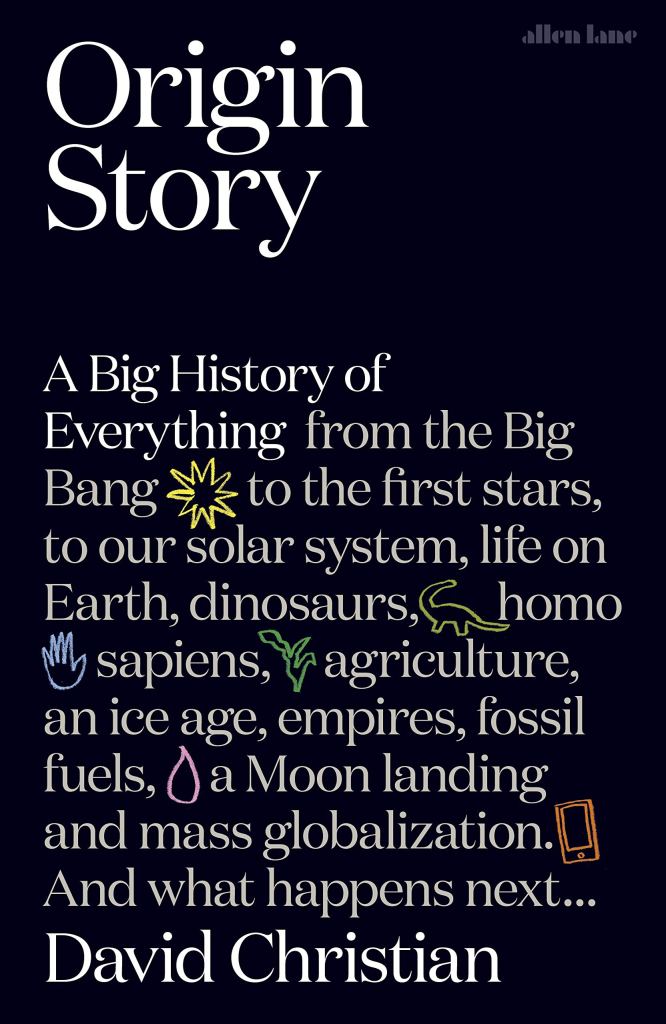
Telling stories is innate to humans and used across many facets of life to describe both the simplest and most complex ideas. Ancient civilisations passed down stories to explain how their ancestors lived or how their land was formed. Today we still tell stories about history and science and everything in between. The story of our universe has many perspectives ranging across the cosmos, our biosphere and humanity. David Christian is a historian who has attempted to provide a unified history of humanity in his book “Origin Story: A Big History of Everything”.
One single history book does not exist, as there are many perspectives. Examples include the story of scientific discoveries, establishment of natural formations, or wars and politics. Christian notes that “we study humans through many different disciplinary lenses (anthropology, biology, physiology, primatology, psychology, linguistics, history, sociology).” He achieves an amazing feat by linking these multiple lenses, including science and cosmology into a narrative to establish our origin story.
The story starts with the scientific evolution of our universe, beginning in a state of entropy, a state of disorder with no clear path. New theories evolve over time, but Christian has successfully unified physics, chemistry and biology with current theoretical models of the universe’s evolution. Christian minimises jargon by expressing scientific processes as transfers of energy between elements turning into life. He carries this concept of energy flows throughout the narrative and applies it to human interactions and the development of civilisations.
Adopting the idea of energy flows again, Christian illustrates how ideas can be captured from our environment. Further probing for answers and growing needs can convert these ideas into reality. He notes the important role that ideas within literature, language, culture and philosophy have played on influencing humankind. Literature is a perfect medium for expressing one’s self, while language characterises how different cultures perceive their environment. Christian provides numerous examples outlining these influences on our origin story.
Christian’s unified history of humanity effectively explains our origins by utilising the most prominent scientific theories to date. He has successfully tied together science and history, while describing their anthropological impacts on modern society. Through applying the idea of energy flows in a narrative form, Christian has assembled a consolidated history of our world as we know it. By continuing to understand the past, we can more effectively predict the future. I would recommend Christian’s book for anyone who is more scientifically inclined, but also curious about humanity’s development.
Are you interested in learning more by reading this book?
 Books for Thought