

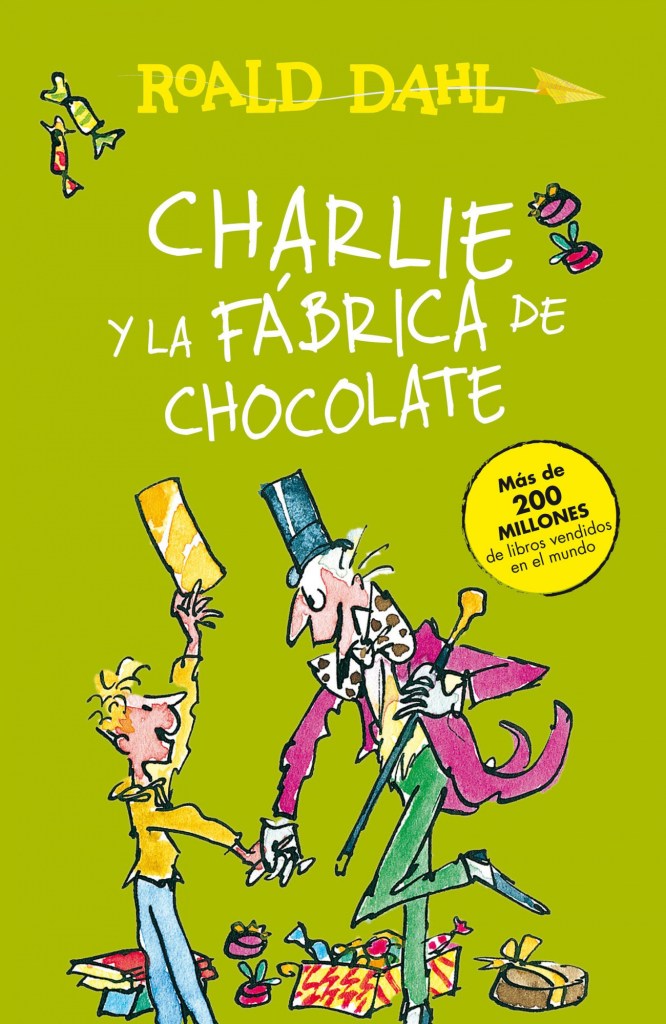
Whether a book is fiction or nonfiction, reading is more than the content, it is also about the experience. After reading the famous book by Roald Dahl, ‘Charlie and the Chocolate Factory’ in Spanish, or ‘Charlie y la Fabrica de Chocolate’, I realised that language is merely a method for depicting a concept. It’s amazing that this book has been translated into many different languages around the world, and when each person reads it, they are all picturing the same story.
Spanish is a language that I am in the process of learning, and reading a book has allowed me to fast track my understanding. Throughout the novel I slowly picked up new words, many were interpreted from the context, or others by translating and slowly remembering that word each time it reappeared. In the case of Dahl’s book, a large part was interpreting words from the context considering I had read the book in English and seen the movie.
Language is one of the many mediums that we use to conceptualise ideas, and whether you are reading in English, Spanish, or even Mandarin, your brain will interpret the text in very similar ways. Other mediums of delivering verbal messages could be through images or physical movements, for example as in sign language.
One lesson I have gained through learning another language is that direct translations for words are not always appropriate. There may be a direct translation for a word between languages, but the feeling of the word can be conveyed differently. For example, there were several occasions in the book where the statement “te tiene un razon’ was said, which literally translates to ‘he has reason’. At first it did not make complete sense, but after analysing the context, I realised it would translate to ‘he has a point’. This is a perfect example where literally translating sentences or words is not an appropriate way of learning a language.
I would encourage anyone learning a second language to read a book or watch a movie, so you can learn how particular words are used in the context of that language. In saying that, the same words in a particular language are also used in different contexts around the world. For example, the Spanish words used in South America would differ from Spain, likewise with English words used in Australia compared to the United States.
While reading in a second language is an empowering skill, reading a novel in your first language will be a much more gratifying experience. It is often the case that when reading in a second language you may not grasp the feelings or emotions the author is trying to convey. These instances are common with the use of slang or words where a direct translation does not exist. But understanding these nuances will allow you to develop an understanding of the language in the context of its culture of origin.
I think this experience has shown me that Oompa Loompas are almost the same whether in Spanish or English. When reading the book in Spanish their personality may be conveyed slightly differently, even though these differences cannot be explained in words, but only felt. It is evident that the translator did a great job, because a successful translation is such that you can visualise the same image in both English and Spanish. I would like to hear your experiences of reading a book in a second language, or if English is your second language, do you think this article would be conveyed differently if written in your native tongue?
 Books for Thought