

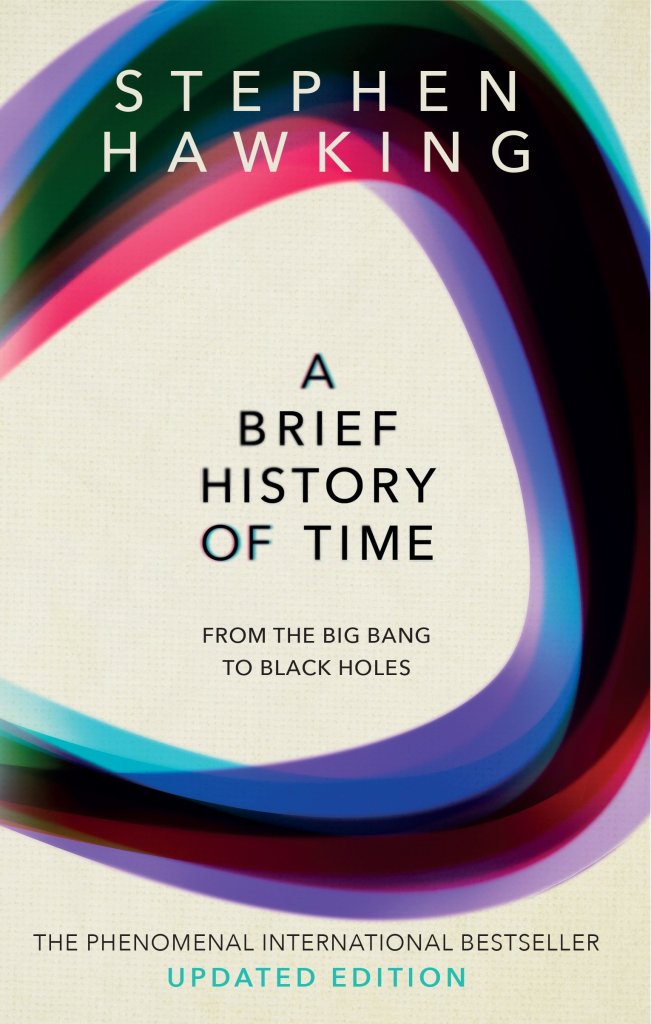
Where did we come from? Can God and science coexist? Stephen Hawking’s book, A Brief History of Time describes the scientific theorems that could explain how our universe was created. While it is known that Hawking’s personal opinion is not religious, he does not dismiss God or religion and still treats them as valid until proven otherwise, as with any scientific theory. This book gives an adequate background to an explanation of the universe, and the historical development of these theories including works from Aristotle, Galileo, Newton and Einstein.
Hawking’s research revolved around demystifying black holes and his determination to find an answer to the universe. Just as several great thinkers before him, he believed that all actions could be described within a unified theory that governs the universe, and would be taught in schools as the norm, just as the theory of gravity. Some people may not see the importance of learning how the universe works, but these discoveries allow us to develop society with new technologies. For example, the discovery of particle physics has helped us understand magnets and electricity which are used in countless applications of our life.
There are questions as to why the universe was created, let alone how. Hawking explains two contrasting anthropic views that could answer these questions. Firstly, does the universe exist because it was created for us and to support our life, or was it just created, and we are simply a by-product out of chance due to its creation. Both these cases influence the theories that govern the universe, and the second case would question the existence of God.
There is still debate as to whether there is a unified theory of the universe, or any explanation at all. Einstein did not accept that the universe was governed by chance, famously illustrated in his quote “God does not play dice”. He was implying that if God was making the decisions on how the world works, there must be a way to determine how the universe functions and a means of quantifying it. While Hawking believes in a unified theory, he also considered that the universe could be made up of infinite theories that explain it more accurately. Examples include concepts such as general relativity, the partial theory of gravity and the partial theories that govern electromagnetic forces. He also raised the possibility that the universe could be completely random and there is no way of making predictions on how it works.
As Hawking described the historical development of theories, it shows that new ideas are always challenging the last. For example, people once believed that the earth was flat until Aristotle questioned this after his observations of the sun and the moon. Today we know that the earth must be round since we can travel on a plane until we return to the same point we started. This example perfectly demonstrates the fact that Hawking’s theories may be disproved with a new theory, or conversely someone may be able to prove Hawking’s beliefs.
The book is somewhat scientific and would require a basic knowledge of physics to understand the content. Even if you struggle with physics, Hawking does a great job at explaining the concepts through simple analogies plucked from daily life. His humor is scattered throughout the book which makes it an entertaining read and provides a welcomed break from heavy explanations. Overall this is a thought provoking book that would suit anyone who is eager to further their understanding on how the universe works.
Are you interested in learning more by reading this book?
 Books for Thought